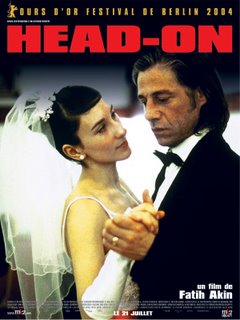
 With the German film Head-On (2004), writer/director Fatih Akin has fashioned a film that is powerful, intense, gloomy, romantic and drowning in the kind of despair that you only get to witness in movies from another country. Head-On is just so unrelenting in its bleak outlook on life that there is no way in the world it would have been made by Hollywood.
Head-On is a great movie and all, but I wonder sometimes why I subject myself to such heavy, unrelenting stories when I could just be watching The Guardian like all the other multiplex loving drones. The answer: deep down (well not that deep as this is a surface love) I love film and the experience of cinema and I don’t care if it’s fun and laughs or tears and anguish that is on display. If a movie is good—I want to see it.
Sometimes film is a raw, painful and harsh experience that doesn’t uplift you in the end. Real life doesn’t always have happy endings. Films like Head-On make me realize just how sugarcoated the entire Hollywood mentality is. I don't need happy endings or sugary romances all the time, I do need good movies.
Head-On is a romance as two people come together in Hamburg and go on a swirling, out of control relationship that is doomed from the moment the pair meet in a mental hospital after both attempt to kill themselves. You’d think that a couple meeting after committing suicide would have nothing left but good times ahead of them, right? Yeah, sure.
Sibel is a beautiful young Turkish woman who is so desperate to get out of her stifling, conservative family she begs Cahit to marry her despite the fact he’s twice her age and basically a step above bumland. Cahit is Turkish and that will please her family. Sibel wants to go out and have sex with lots of guys, do drugs and live it up while pretending to be married. Cahit is drunkenly buried in the grief of his wife dying. It’s a match made in heaven afterall as Sabil convinces Cahit of marriage after she sticks a shard of broken glass into her veins. Didn’t I say this was a romance?
Head-On does not flinch. Not once. It swims in so much despair from beginning to end that I felt a wave of gloom weighing me down when it ended. There are moments when you feel hope in your heart for these two lost people but Akin doesn’t want to make that kind of film. Head-On will stick to you for days after you have seen it—can a film like The Guardian say the same?
Head-On is one of the saddest, most depressing films I’ve seen all year, but it’s also one of the best, as I admire a film that is brave enough to look despair in the face and not look away.
 I love magic. I am particularly fond of magicians and escapologists in the early parts of the 20th century. In fact, Harry Houdini is one of my all-time historical figures. I’ve even been to the Houdini museum in Appleton, Wisconsin to further investigate the man and his life (magic geek!). 2006 is a good year for period magic lovers as we get not one but two films set in the early magic world with The Illusionist and then The Prestige following later this year.
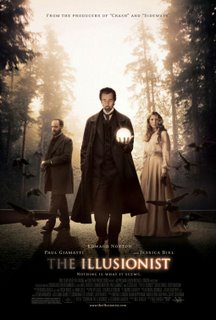
It’s easy to see why I really enjoyed watching The Illusionist, a romantic drama set in turn of the century Vienna, as all of its elements are things I’m into. First, there is a lot of great magic in the movie, the film delves into the world of spiritualism (another interest that is often connected to magicians during this period) and The Illusionist also has a romantic, mysterious story that reeks of atmosphere thanks to director Neil Burger. Magic, romance and mystery—what’s not to like?
Edward Norton plays the new to Vienna conjuror Eisenheim. Audiences are quickly awestruck by the otherworldly quality of his act and word spreads to the pompous prince Leopold (Rufus Sewell) that here is a magician who might have tricks too complicated for the prince to figure out.
The story develops a romantic triangle when Eisenheim’s teenage love Sophie (Jessica Biel) shows up as the soon-to-be-bride of Leopold and the pair haven’t seen one another in fifteen years. Sophie is drawn to the intense Eisenheim but the pair’s relationship puts them in jeopardy from Leopold and his police inspector (Paul Giamatti) who hounds their every move.
The Illusionist is drenched with period atmosphere thanks to some nice choices by Burger regarding the look of the film. He wisely chooses to create scenes awash in hazy, soft focus images. He uses iris techniques to further give the film a period feel. The atmosphere and look of the film is one of dusk and romance and this adds to the romantic elements already in the film’s story.
The scenes filmed in the darkened, intimate theatres, candles flickering at the front of the stage, as Eisenheim entrances the rapt audiences, were thrilling to watch. It’s some of the best magic scenes I’ve ever seen in a movie—actually, there hasn’t been much in the way of these kinds of scenes over the years. From what I’ve read of the era—these scenes seem very authentic as I watched them.
In a way, I’m an easy mark for this film just based on the magic scenes alone, but luckily, The Illusionist is about more than just Eisenheim doing tricks. There is a lot to enjoy here—the romance and mystery of the story offer as much satisfaction as the terrific look, production design and magic. After seeing The Illusionist and enjoying it so, all I can think is how long before The Prestige comes out?
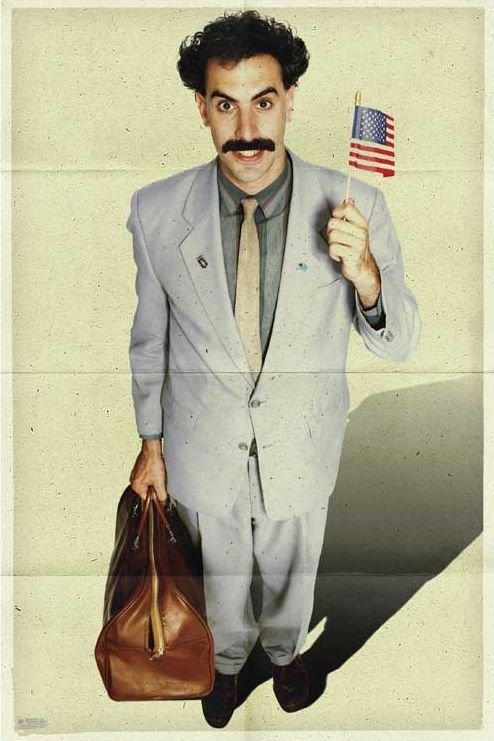
 Circle this date on your movie going calender: November 3rd. That's the scheduled release date for Borat and one of my most eagerly awaited films of the year.
The trailer is hilarious, word of mouth is the film is too. Borat! Borat! Borat!
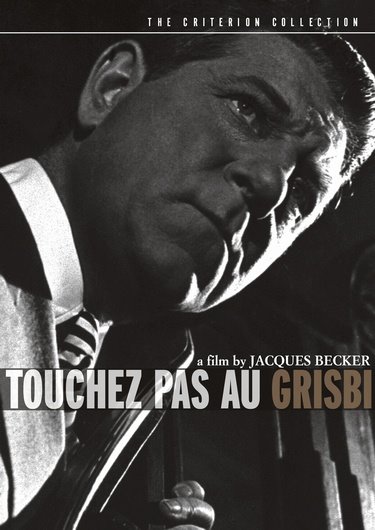
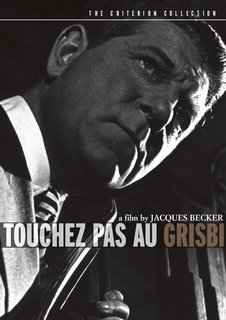 Touchez Pas au Grisbi (Hands Off the Loot) is one of my favorite films I’ve seen all year. I’m kind of ashamed I’d never seen it since I love films about heists, criminal behavior and gangsters. What kind of film robot am I to have missed this unbelievably good gem from 1954 and director Jacques Becker? I loved this movie!
Jean Gabin plays Max, a weary, well-respected, aging Parisian gangster who has just pulled off a massive heist of gold with his long-time partner Riton. The pair plan on letting the gold sit for a while but Riton can’t keep his lips shut to his flighty, dancehall girlfriend Josy (played by Jeanne Moreau). Naturally, Josy is two-timing the older Riton and she tells her younger lover (also in the criminal underworld) about the gold and soon Max, Riton and their gold is in serious jeopardy.
Hands Off the Loot is a sheer joy from the very first shot of the film. Becker is in complete control of the film and has crafted a wonderfully understated film about gangsters in Paris. Every shot in the film is composed and thought out—I’m terribly impressed with the level of detail that is packed in the ninety-five minutes the film runs. There is truly not a wasted moment onscreen. Becker lets the story unfold in a patient way that is the hallmark of a great director.
Another thing I loved about Hands Off the Loot is the assured calmness of the performances and the story. Gabin is intense and soft spoken as Max (but he’s not above bare hand slapping some people if he needs to get rough to get some answers in a hurry. One of my favorite scenes has him slapping three different people in about 12 seconds when they don't tell him what he wants to hear.) and by the end you are truly sympathetic to him and his loyalty to Riton. Here is a man who is a gangster, yet he's a gentleman and lives by a moral code even though he makes his living robbing people.
Becker drowns Hands Off the Loot in so many great images and details its impossible to list them. We see nightclubs, on the lam hideouts, restaurants catering to other gangsters, various groups of gangsters holding conversations while discussing future jobs, dark lit streets and stairwells and other classic noir haunts. The film is shot in such a wonderful lustrous black and white that color would have ruined the film. As it stands now, Hands Off the Loot is an ageless story that comes off romantic considering the subject matter, location, the look and the sound of the film.
My favorite kind of gangster films are the ones that make me want to be a gangster—Hands Off the Loot is such a film. I’m really kind of stunned I’d never heard of Hands Off the Loot, as after only watching it once I’m ready to put it into the list of my favorite gangster films of all-time. Hands Off the Loot is that good a movie. Highly, highly recommended.
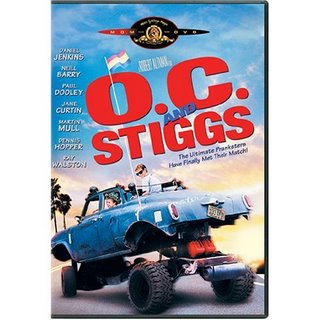 A few months ago when the Circle was screening A Prairie Home Companion a few young people in their early 20s/late teens came up to me with the bold claim—“Robert Altman has never made a bad movie!” with all the enthusiasm youth can muster. I’d say to them, “Well, he’s made a lot of movies. None of them were bad?” while thinking of recent duds like Dr. T and the Women and Pret-a-Porter (which was a flaming disaster!). I love Altman as much as anyone but come on, he’s made more than his fair share of failures over his fifty plus years as a director.
Case in point—O.C. and Stiggs from 1985 sees Altman trying to make a ribald teen comedy that satirizes all the ‘80s style teen films from this era. Altman claims to “hate” these teen films on a DVD extra but his satire just doesn’t ring home and comes off as just another zany teen film in the end.
The film is about two oddball teens that are waging a war of revenge against a local Arizona insurance salesman who ripped off O.C.’s grandpa from his retirement fund. The boys pull off a very unbelievable string of stunts to get back at the man and his caroonish family. Very little of this is either funny or entertaining. In fact, both O.C. and Stiggs are mostly annoying!
The boys also go on a trip to Mexico—which is ridiculous as they raft down rivers on tire tubes!—get an absurdly tripped out car (see movie poster), meet up with Vietnam vets who still think they are in a war (Dennis Hopper spoofing his Apocalypse Now performance) and even woo a girl or two. Sounds pretty much like any number of films fitting the ‘80s teen film genre, right?
O.C. and Stiggs isn’t terrible or painful to watch but that doesn’t mean it’s a good film. The film is too confused, the performances are too over the top and silly, it's not funny and it’s too long to be good (or even average). The reason it’s extremely forgettable, while the films that Altman hates aren’t, is those films had a clear direction in story—O.C. and Stiggs is a wildly uneven picture that wants to be a clever satire but comes off as just a poorly conceived film.
I think Robert Altman is one the best living filmmakers making films and all, but he’s not perfect and O.C. and Stiggs is one of Altman’s failures. Those youngsters who came up to me making bold claims just need to make their way to this one and they might rethink their statements. Believe it or not, there are some films in Altman's past that don't work and O.C. and Stiggs is firmly on that list.

 I loved the set up of the 2005 documentary Reel Paradise: a man (John Pierson) who has done a variety of things in the indie film world from producer to TV host (IFC’s Split Screen show) moves to a remote village in Fiji (Taveuni) with his wife and two kids and dedicates a year of his life to showing free movies to the locals at a fifty year old movie theatre called 180 Meridian.
Wow, is that an idea that appeals to me and here’s why. I obviously love movies or I wouldn’t be doing CineRobot. Also, I am drawn to the notion of living in isolated, remote locales and the notion of spreading the sheer joy of the “film experience” to people in such a place just really kick starts my dreamer heart.
The 180 Meridian is a ramshackle structure with torn up seats, windows that go open-air, is powered by a generator and utilizes an old, quirky projector. Every screening is an experience and the theatre is packed most of the films shown over the month the documentary was filmed. I wish filming would have taken place over more than a single month as I would have loved to have seen more movies screened at the 180--as it is they get to see all kinds of films from Jackass to Apocalypse Now Redux.
My favorite part of Reel Paradise was how director Steve James (Hoop Dreams, Stevie) would focus in on the locals as they watched whatever film was being screened. More often than not—the bits of business and broad physical comedies were especially popular—the audience lapped up the images as if they were starving. It’s magical to me to watch the glowing faces of the crowd as they laugh or concentrate on something flickering in the dusty light of a movie theatre in Fiji. They are caught in a 24 frames per second spell. It’s the same spell I’ve been under my entire life.
The film was probably too long and I could have done with a lot of the family drama that was also filmed—rebellious, bratty sixteen-year-old daughter got old real quick. But, if you are like me and love movies and the whole idea of what they represent, Reel Paradise is a charming documentary about a little movie theatre at the far ends of the earth.
 I’d always read about this 1975 Maysles Brothers cult documentary about a mother and daughter who live an eccentric lifestyle in the very upscale East Hamptons, NY but just got around to seeing it. Glad I did because it’s a strange and intimate portrait of two originals that are completely disconnected with the world around them.
The dilapidated mansion, dubbed Grey Gardens, is a squalid, falling down structure with holes in the walls, dirt everywhere, raccoons living in the attic (fed bread and cat food by Little Edie), numerous cats roaming the house and brush overtaking the outside. The doc opens with clippings from newspapers about it being declared off-limits to the Beales until it was cleaned up. They get to move back in but the house is still an utter mess.
The mostly bedridden “Big” Edie and her daughter “Little” Edie, spend ninety minutes in or outside the house in various states of argument, song or conversation. Both love every second of attention that the camera gives them, which makes me doubt the honesty in their actions at times. The Maysles film the goings on with a level of intimacy that draws the viewer into the oddball ramblings and philosophies of both Edies.
Grey Gardens is a strange little doc that reminds me of another documentary filmmaker—Errol Morris. This story is right up his alley but without the structured interviews he’s known for. The Maysles just try and capture the Beales roaming the house, engaging in odd conversations, as they are likely to do every single day.
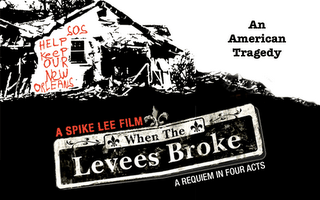 I'm loathe to get political on CineRobot but after watching When the Levees Broke, a recently shown on HBO documentary by Spike Lee that chronicles Hurricane Katrina and its ghastly aftermath, I have to mention certain politicians after seeing it.
What struck me as I watched this is that the hurricane did a tremendous amount of damage to the city but it can’t compare to the damage done by the federal government, FEMA, inept local politicians, the Army Corps of Engineers, insurance companies, some neighborhood never do wells and a host of other people after the storm. As usual in cases like this, those that have paid the price have been decent, tax-paying, insurance buying people from children to senior citizens.
When the Levees Broke is a riveting four hours that will make you completely angry and boil your blood regarding what happened during and after Katrina to these people. The one-year mark just passed the other day and President Bush made grand statements about “never forgetting” and “rebuilding” the city—but his words are so unbelievably hollow in the face of his actions during this disaster that it makes me sick to my stomach. Bush's disregard for these people is tantamount to a criminal act in my opinion. Sure, the mayor and governor were incompetent too but the president should have taken control IMMEDIATELY when he saw that these events were over their heads. That is what presidents are supposed to do, right? They are supposed to take the initiative in a disaster situation, right? Bush didn't. Bush failed these people.
I don’t know why the government has held these people in such disregard or contempt since the disaster but I’ll wager a guess: class and race. These are largely poorer people who also happen to be African-Americans and let’s be honest here—poor, black people don’t quite register with this administration. Had these neighborhoods been full of wealthy white people the levees would have never been allowed to get dirty much less break. This is just one more example of Bush’s lack of concern with a segment of the American population and it’s kind of sickening to see from an American president.
Lee has assembled a diverse and varied collection of individuals who either lived through the disaster or have some level of expertise to the region. The anger and pain in most of these people is so palpable that it jumps from the TV screen. When the Levees Broke is a mesmerizing documentary that is horrific and painful to watch, it’s also surprisingly inspiring to witness the resolve of the New Orleans people as they face down a government that doesn’t really give a damn about them, their histories or their future.
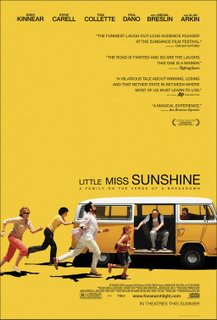 Sometimes I see a much-hyped film like Little Miss Sunshine and I spend the entire movie wondering why this film is being fawned over by press and audiences alike? The first hour of this dysfunctional family comedy I didn’t laugh at all. Maybe I was in a bad mood or something? Maybe it was the crowd around me that caused me to not enjoy what I was watching? Maybe the film was not as good as advertised?
But miraculously, as sometimes happens, the film won me over and the ending was probably the best ending I’ve seen all year in a movie. It’s a funny, joyous, unpredictable and full of life ending and it completely changed the way I thought about Little Miss Sunshine. Now I’m thinking of watching it again to see if I misjudged the early bits.
I think a big problem in my enjoyment of Little Miss Sunshine was the fact I went to a free screening at the local crappy multiplex. If you’ve ever been to one of these freebies you know they stuff them full of chattering yahoos, who are there to see a free movie regardless of what is being screened.
Well, I found myself sitting next to a young girl who couldn’t have been older than ten who guffawed and laughed every single time people around us laughed. Little Miss Sunshine has a smart script, full of sometimes sophisticated dialogue about Proust, Nietzsche, suicide, drugs and other “adult” subjects.
Frankly, I just do not believe this kid understood what was happening well enough to find the material so humorous. Unless, she’s some kind of savant or is really sophisticated but I swear this girl was about nine years old. Listening to this kid laughing and covering her mouth started to really annoy me and I couldn’t really get into the story. Seriously, it was worse than a cell-phone going off next to me.
Then the ending was on me and I really loved the last part in spite of the phony laughing of the kid next to me. So, I’m confused. Was Little Miss Sunshine a lot better than the first hour seemed? If the entire film was as good as the last twenty minutes (especially the ending), then I let some kid ruin a good movie experience.
One thing is for sure, I don’t know why I keep going to those crowded free screenings, as all they ever do is frustrate, distract and annoy me. I guess the "free" keeps enticing me no matter if it means I'll sit next to some person who will irritate me the entire film.
 It seems every month I see a great little music documentary about some band or scene or style of music. August’s entry is the English documentary Made In Sheffield that is on the short side (slightly under an hour) but one that I really enjoyed.
I think the post-punk period from say, 1977-1984 was perhaps the most creative and vibrant period in sheer diversity and newness in rock n roll history. Sheffield was known for their collection of bands in the late 1970s and those bands are chronicled in Made In Sheffield.
What makes this film really timely is that post-punk music has seen a massive “re-birth” in the past few years as every hipster band on the planet it seems has suddenly discovered albums and bands from this era. The kids seem to like all these new bands but the fact is they are largely mimicking a lot of these post-punk bands from 20-30 years ago.
Born in the frenzy of punk rock, post-punk is a much more interesting form of rock music from this era. Punk rock may have kicked down doors and limitations but it quickly became music of stasis, frozen by the rigid narrow mindedness of those writing the so-called rules. To me, punk rock quickly became a reactionary style of music and most of it hasn’t held up artistically in the passing years.
Post-punk though, it is a completely different animal with a wildly diverse collection of groups that relied on guitars AND synthesizers AND anything else that pushed the boundaries of sound and music. The goal was to create new sounds and there were no rules. While punk rock bands were too busy in creating rules that limited what they could do and who could be in the club, post-punk bands were busy making far, far superior music that holds up much better over time.
One reason I'm so into this is I love analogue synthesizers. The synthesizer is the most revolutionary instrument created in the past 40 years, as it’s the only modern, futuristic instrument not based on some string instrument of the past. I have a long running love affair with music made with synthesizers and the zenith is the 1978-83 period that sees a lot of attention in this documentary. So, any film with early Human League footage is going to be adored by me and Made In Sheffield has that and so much more.
Here’s the bands you see and hear about in the film: The Human League, Heaven 17, ABC, Caberet Voltaire, Pulp, Artery, The Future, Vice Versa, 2.3, The Extras, I’m So Hollow, Comsat Angels, Clock DVA and even Def Leopard (!). That’s an incredible list—a few of them I’d never heard of but was blown away by footage I saw in the film—Artery and I’m So Hollow were great and I’m going to look for records by them the first chance I can.
Made In Sheffield is a short look into a city who had a brief explosion of musical creativity in the late ‘70s and whose bands were influential at the time and that influence is still felt thirty years later. Highly recommended for music lovers.
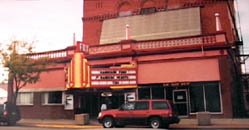 I’ve been out of state the past week +, New Mexico mostly. Of course, I happened to catch a few films while I was traveling. The best thing about the films I saw was getting to see one in Trinidad, Colorado in a really special old movie theatre called The Fox. More later about that.
In Santa Fe I saw the French action film District B-13. Yes, I wrote “French action film” in that sentence. It’s not a style of film that I’d connect with that country but there are a few good ones from France—La Femme Nikita and Brotherhood of the Wolf are a couple that jump out of my memory.
District B-13 has some thrilling action and chases moments—it’s a style that is known in France as Le Parkour. Le Parkour mostly involves jumping off buildings and using urban elements as props that the participants react off of. So, you’ll see lots of full-on running, jumping, swinging and climbing these urban locations and in District B-13.
Le Parkour is the best thing about District B-13 as the fight scenes get repetitive and the story/script is a bit dodgy but on the whole this is a fun twist in the action genre.
On my last night in Santa Fe I got to see Talladega Nights: The Ballad of Ricky Bobby and thought it pretty humorous. The first half of it I really enjoyed as it has some really unhinged, absurd moments. The last 1/3 begins to drag a little but it’s just so goofy and silly that I had a great time watching it.
The best thing about seeing this was I got to see the trailer for Sacha Baron Cohen’s Borat. I’m a big fan of Cohen’s and Borat looks absolutely hilarious.
As mentioned, I saw a film in Trinidad, Colorado at the Fox Theatre. I was staying in Raton, New Mexico and on a whim decided to drive the twenty-one miles north across state lines to see if there were any old movie theatres in Trinidad. I hit jackpot with this 1908 beauty.
The Fox was an absolute behemoth that I could see from the highway as I drove into town. I paid my $5 to watch Pirates of the Caribbean: Dead Man’s Chest and entered the cavernous room that was darkly lit. The Fox has seen its better days as it is kind of falling into disrepair but the place reeks of history. There were ghosts of nearly a century of people watching movies in the place and those ghosts were sitting right there with me.
Pirates of the Caribbean sucked. Big time. This will be one of my least favorite films of the year. The story with all the supernatural stuff was absolutely ridiculous, the script too. Johnny Depp’s performance as the fey pirate rogue was charming in the first film—here he’s cartoonish and overacting most of the time. Come on Johnny, you are better than that. Orlando Bloom and Keira “Fake Top Lip” Knightley were there usual awful selves. This movie is raking it in too, ugh, it hurts me when movies are really bad yet get swept up by the masses.
After the film I got to go on a tour of the Fox by Michael, the projectionist and manager. I got the Fox history, went backstage (it was originally a theatre called the West) and even up to the second balcony. There are two balconies in the Fox! They sit on top of one another but the top one—which has these super tall wooden benches hasn’t been used in decades. I left Trinidad after spending an hour looking in all the secret hidden places of the Fox as midnight came and drove back to New Mexico. The Fox may be slowly crumbling but I loved spending some time in it as cookie-cutter multiplexes have nothing theatres like that. Seeing a movie at places like the Fox is real movie watching, not going to the depressing AMC 20 and their ilk.
I was driving home to Tulsa through the panhandle and on a whim stopped in Guymon to watch the horror film The Descent. I’d seen director Neil Marshall’s Dog Soldiers (about werewolves attacking a group of soldiers) a few years ago at a midnight movie in Seattle and really liked it so I was kind of excited to see The Descent.
The film starts out as a kind of all-girl survival film as a group of thrill seeking women enter a scary looking cave to do some rock climbing and exploring. They encounter much more than being able to climb down and back out as something might be living down in the cave.
Ah heck, if you’ve seen the trailer, you know something is down in that cave and the film turns into a complete f'n bloodbath. I’m talking serious gore. I love the gore and caves, with their small, claustrophobic spaces kind of freak me out, so I liked this film.
Although Marshall tries to give the film deeper subjects, The Descent is pretty much attractive girls crawling around in caves with some serious bloodletting. What’s not to like about that? The weird thing is the film could have been a straight up survival thriller about whether or not these women could find a way out of the cave but then these cave creatures show up and start killing and it’s suddenly a completely different film.
There you have it, four films, three states including stops in out of the way places like Trinidad and Guymon.
 Stories that have someone transformed by single moments in their life fascinate me. Sometimes the moments are enormous while sometimes they are small enough to almost slip by. It’s one of these tiny moments that change Schultze’s life almost overnight. Schultze Gets the Blues is a completely charming German drama/comedy from 2003 that had me under its spell from the beginning.
Schultze is a quiet man who gets “retired” from his job in a salt mine (parting gift: a salt lamp that can light up or be licked for salt). He spends his days doing not much of anything whether he’s alone or spending time with a couple of other guys who were also retired. He fishes from a bridge, he watches his buddies play chess and he plays accordion in the local polka band. Life is simple. Every day is a day of routines.
Routines change when one evening he is flipping through the radio dial and hears a form of accordion playing unlike anything he’s ever heard: zydeco! Schultze is bewitched and a tad confused by the ramped up accordion playing in the song. He tries to walk away but can’t. Soon the song is barging its way into any normal polka song that Schultze tries to play and he's cooking Cajun food for his buddies.
Schultze soon goes on a journey that he would never had noticed beginning had he not paid attention to this song on the radio. It was his nearly invisible moment but Schultze noticed it and let it change him. Sadly, I don’t think many of us notice these kinds of moments in our lives. Or, if we do notice them, we surely aren’t brave enough to let the moments take control and alter our path when we are faced with them.
That is what’s so sweet and rewarding about Schultze Gets the Blues—it is chock full of the notion of giving yourself over to the innocence of something new, anything new, no matter where the idea, the feeling or the moment leads you. To do that takes courage and Schultze might be quiet and soft spoken, but he’s got a lot of courage. And he's got a desire to play that zydeco!
There is very little dialogue in Schultze Gets the Blues and I get the feeling most of the actors aren’t professionals (at least the supporting roles)—something I actually like most of the time as it lends a realness and natural quality to a film if done right. Even with little dialogue, the film flashes by in a blur because it’s just got this magical story to it that swept me up.
Schultze Gets the Blues is one of my favorites for 2006 and is especially recommended for music lovers and romantics (or anyone else who just wants to see a/ a good movie or b/ a movie that makes you feel great to be alive!).
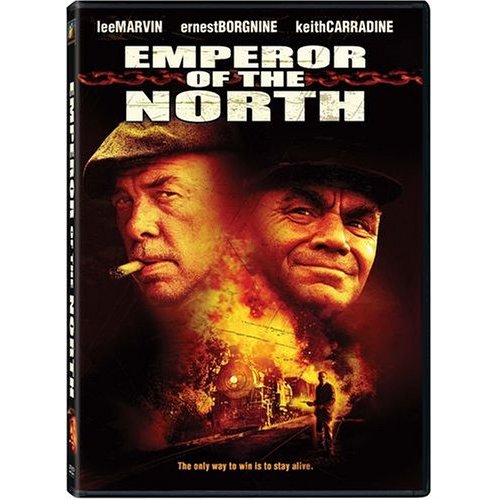
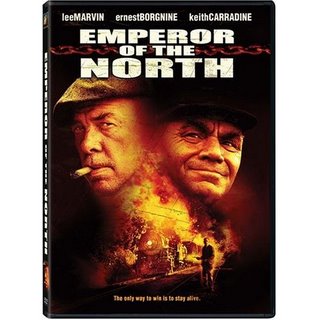 I’m always ready to watch a film set among hoboes, wanderers and others lost in the void of the Great Depression. Maybe it's the Grapes of Wrath existence a lot of my relatives lived during that period? My grandpa Benton had colorful stories about riding on trains during the 1930s. So, it's not a surprise I'd take a liking to Emperor of the North with hoboes battling the railroad cops who desperately try to stop them from riding their train.
Rail workers and train riding tramps were notorious enemies in this era. There was a savage brutality that often ended in blood spilling and even death. Early on we get to see how serious this can be as the meanest S.O.B. of the train cops—Shack (played by the great Ernest Borgnine)—takes his big hammer to a free rider's skull and he’s soon cut in half by wheel on rail.
Emperor of the North, which is based on a story by Jack London drawn from his experiences riding the rails, tells the story of such a battle between men. Lee Marvin plays A-No. 1, a tough as nails, seasoned ‘bo who decides to take on the sadistic Shack. No one has ever ridden on Shack’s No. 19 train. Nobody. The men battle wits and brawn as the train heads west. When I say battle I should include the list of weapons: fist, hammers, axes, boards, chains and wits.
The film is an odd mix of action, gritty ‘70s pulp cinema and social commentary. It works wonderfully. I loved seeing how A-No. 1 and Cigarette (an inexperienced tag-along ‘bo played by Keith Carradine) tried to ride No. 19 while Shack attempted to get rid of them any way he possibly could to save his reputation.
I also loved seeing all the hobo groups and camps talking it up with their slang, nicknames (other ‘bo names were Hogger and Hee-Haw Mike) and gambling up a storm on whether A-No. 1 is the first to ever ride the No. 19 train and live to tell about it. It was a hard life to be a tramp during the depression but the men seemed to have a code and community all their own.
Plus, these were REAL stuntmen doing something called stunts in Emperor of the North! No komputers were involved in any stunt in this movie. When you see a guy fall off a train backwards in Emperor of the North, it’s a real person risking life and limb for the sole art of making a picture better. Action films now are just a bunch of phony komputer aided scenes stripped of the danger because nothing is real. There’s something missing in the spectacle of the CGI films now because that “realness” has been lost.
Emperor of the North is just another example of a hidden gem from the 1970s. That decade had so many great films it’s unreal compared to now. Even their b-films like this were a lot of fun and more interesting than most of the pap out now. This is a fun film that has an epic train throw down from two of the all-time Hollywood tough guy actors in Lee Marvin and Ernest Borgnine and is worth seeking out.
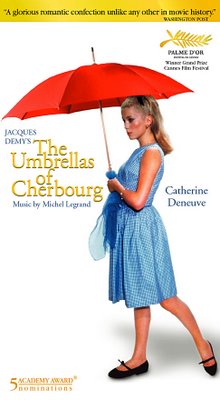 I’ve always meant to watch Jacques Demy’s 1964 French musical The Umbrellas of Cherbourg but never got around to it until a hot Sunday afternoon in Oklahoma. The opening straight down shot with rain falling on cobblestones as people with a variety of colored umbrellas transported me straight to France and away from the 100+ degree heatwave that exists in Oklahoma for the past few weeks.
This movie feels so unmistakably French, from the vibrant colors of the Gallic interior wallpapers to the quaint narrow streets with shops such as the family umbrella shop a 16 year-old Genevieve works with her widowed mother. Genevieve is in love with Guy, a 20 year-old mechanic who her mother doesn’t approve of. The pair coo, coo and more coo every time they are together in the kind of teenage French love that looks so romantic to see on film. Ah, to be in love while a teenager in France in the late 1950s!
Problems ensue when Guy gets drafted for two years of military service and Genevieve meets a suitor who is more suave and successful than Guy. Will she wait for him to get out of his military service or will she decide to marry this other man?
The Umbrellas of Cherbourg is a musical unlike any musical I’ve seen because the cast sings every line of dialogue in the film. Every line. At first I was thinking, “I don’t know about this,” as I’m not a huge musical genre fan, but the story is so lavishly photographed, romantic and Catherine Deneuve is so beautiful as Genevieve, I got into it.
The singing and color-drenched scenes make the film feel light as air but there is a real sad, bittersweet quality to the film as it evolves. I wasn’t expecting The Umbrellas of Cherbourg to have such a powerful ending but it’s the ending that will really give this French romantic musical its staying power when I think of it.
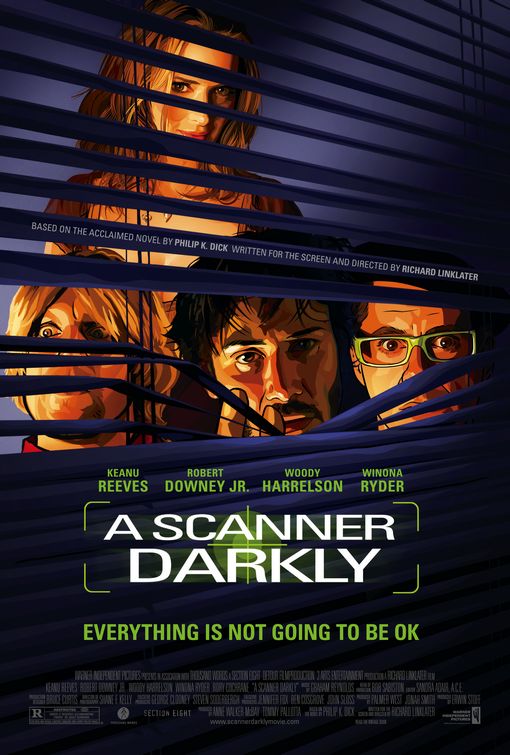
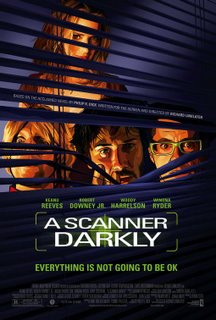 I’ve been eagerly waiting the release of Richard Linklater’s adaptation of Philip K. Dick’s novel A Scanner Darkly. I’m a long time fan of his novels—he’s one of the most respected, influential and interesting science fiction writers in the history of the genre—and enjoyed this version of one of his books I have not read.
PKD’s books are often dense, convoluted and strange trips into the mental workings (or mental falling apart) of his characters—fantasy and reality are often indistinguishable in PKD’s world. You never really know what is happening and what is real in a lot of his stories. This is certainly the case in A Scanner Darkly as it’s a bizarre trip into a world of drugs and paranoia (that’s another of PKD’s favorite topics) as various characters fall to depths because of the drugs they are addicted to.
Keanu Reeves plays an undercover cop named Bob Arcter who becomes addicted to the drug “Substance D” (the “D” stands for death). It’s a highly addictive drug that a major chunk of the population is addicted to. No one knows Arcter’s identity in the police force because he wears a “scramble” suit that has over one million images of people and clothes flickering over it at all times. It’s a neat trick and one of the only overt sci-fi inventions or elements in the film, yet, A Scanner Darkly is still a sci-fi film at its core.
Arcter spends his time hanging out with fellow drug fiends in a squalid house while slowly losing more and more of his faculties and mental clarity because of his taking substance d. He takes tests at the police mental health department and talks to his boss--whose identity is also a secret as they too wear a scramble suit.
That’s the simple version of A Scanner Darkly. It’s way more complicated and intricate than that. The script incorporates a lot of PKD’s interests into it—psychology, philosophy, religion, the perception of the world around us, morality, personal choice, the paranoid state of man, the always present split personality of humans and drugs as objects of control and ruin are all given time in the story.
The film has a great cast with Robert Downey Jr. and Woody Harrelson providing some funny moments as people in Arcter’s sphere who are even more whacked out than he is. Both of these actors are known for being able to deliver an eccentric performance with the best of them and they rise to the occasion nicely. I was also so happy to see Winona Ryder make a nice return to the film world as Arcter’s “sort of” girlfriend and part-time drug dealer.
A Scanner Darkly is animated in the same way Linklater’s A Waking Life was—with each individual film frame painted over after the actors were filmed with traditional film techniques. I liked seeing the story this way as it really fuels PKD’s hallucinogenic story and takes it places that it wouldn’t have gone—the fantasy scenes for example—had it been strictly shot on film.
A Scanner Darkly is interesting, complex, dark, humorous, bleak and will make you work a little harder for your sci-fi as its not one of these aliens and effects sci-fi films—it tries to dig deep into the human mind and the objects that control and destroy us. I think Philip K. Dick would be very happy with this adaptation if he were alive.
 I'm a big fan of the TV show The Shield and was very happy to see Forest Whitaker join the cast last season. As I watched him go up against the rogue cop Vic Mackey I remembered how much I love to watch Forest Whitaker act. He's every bit the match for Mackey and Whitaker crafted a dangerous, complex, electric character to watch. This is something that Whitaker has done a lot in his career (uhm, not counting Battlefield Earth).
Whitaker has also directed three motion pictures but surprisingly all of them are much lighter—and not very good—than what he usually chooses as an actor. For example, in 2004 he helmed the underwhelming Katie Holmes vehicle First Daughter and it's a predictable, sappy, not very good film pumped full of way too much saccherine. It's kind of baffling he'd choose to direct a film like Hope Floats after being in something as cool as Ghost Dog.
Here are some of my favorite films Forest Whitaker has been in that should be seen:
Fast Times At Ridgemont High (1982): Whitaker plays Rigdemont High's star football player who goes on a mauling rampage against Lincoln High after his little brother and Jeff Spicoli (Sean Penn) wreck his car and make it look like Lincoln High did the damage. It's a small role but his snorting, vicious football player is one of many memorable performances in one of the best high school comedies ever.
Platoon (1986): Oliver Stone's Vietnam epic is an enthralling look at the everyday soldier as they become lost in the psychological mayhem of war. Whitaker gets to show what kind of intense actor he will develop into in the future with his role as «Big Harold».
Good Morning, Vietnam (1987): I haven't seen this since it came out so I'm not sure it's dated well but this is a vastly different Vietnam War picture for Whitaker than what he did in Platoon. For one thing, had Robin Williams been in the gritty Platoon he would not have made it a week if he acted like he normaly does.
Bird (1988): Whitaker delivers maybe the performance of his career in this Clint Eastwood directed bio-pic of bebop jazz legend Charlie «Bird» Parker. Whitaker owns the screen in virtually every scene in the picture and even makes it look like he knows what he's doing with a saxaphone.
The Crying Game (1992): Wonderful, twisted movie from director Neal Jordan that sees Whitaker embrace another brave role as an actor. This film was kind of a cultural event picture because of a turn in the film and was the last really good film Whitaker would do for seven years.
Ghost Dog—The Way of the Samurai (1999): Whitaker broke out of the sub-par cycle in this very cool film from writer/director Jim Jarmusch. Whitaker plays a kind of urban samurai who gets mixed up in some nasty business he has to use his code to make it through. Maybe the coolest character and movie that Whitaker has ever done.
I'm hoping Whitaker's performance in The Shield will get him some interesting roles again—he deserves them! Those above are some of his better films and performances that must be seen if you like Whitaker.
 I caught Mission Impossible 3 yesterday at the dollar theatre and I confess, I spent the entire movie hoping that Philip Seymour Hoffman would get to «kill» superspy Ethan Hunt. The reason—Hunt is played by the always grinning, always annoying Tom Cruise. Heck, I was so caught up in rooting for Hoffman's bad guy I was hoping he'd off Cruise on-screen wife in the process of killing the high powered Scientologist. Kill anyone and everyone in the path to getting to Cruise/Hunt!
Hoffman, whose never gotten to play the bad-ass action villain, gives a snarling try of it, but it shouldn't come as a surprise to know that he fails. What? Don't tell me I spoiled the ending for you, this is a Cruise action blockbuster afterall. Maybe Hoffman can get Cruise to slum in a little movie sometime and «kill» him in that. I would be a happy robot just to watch him die in anything.
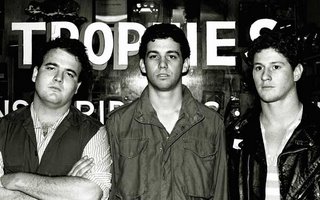 The past couple of years has seen a spate of great musical documentaries released—New York Doll, The Devil and Daniel Johnston, Dig!, Moog, Some Kind of Monster, The Fearless Freaks and The Nomi Song are all music based docs I've seen since 2005 and liked. Add We Jam Econo to that growing list.
Tim Irwin's We Jam Econo is the story of the San Pedro punk rock band Minutemen. Minutemen weren't really punk rock, yet still, were more punk rock than the vast majority of bands that sprung out of Southern California hardcore scene during the late 1970s/early 1980s.
The doc follows their early beginnings, going back to junior high school when D. Boon and Mike Watt met, all the way until Boon's premature death in 1985 from a car wreck. It's sad to see how commited and passionate Boon was on stage and to know it all ended much too soon.
Because of their style, kind of a punk, funk, jazz fusion beneath furious political shout outs, Minutemen never got the acclaim or due the fans of the band think they deserve. Those fans, a multitude of famous musicians, and extensive interviews with Watt and drummer George Hurley create the framework of the documentary.
The real star of this is all the performances of Minutemen in various small clubs. The songs are short bursts of raw energy that combine all these styles of music in a punk rock setting—sometimes to the dismay to narrow minded, rigid audience members who had already created a set list of what a «punk rock» band could and couldn't sound like. Nitwits.
Boon, who is a large man, dances all over the stage while singing/screaming along with Watt while Hurley pounds away and pulls of complicated drumming moves. It's a vivid look at what it was like to be in such a band during this era and shows the band in their proper element—performing on stage.
We Jam Econo is a great addition to the ever increasing library of rock history documentaries. It sheds light on a band that may have slipped off the radar to rock fans and one of the more interesting front men ever in D. Boon.
 To continue the previous post—here’s some more films I’ve watched the past few weeks.
The Warriors (1979). I hadn't seen May's midnight movie at the Circle in over 15 years so I was really excited to watch it for the first time ever on a film print—and at midnight to boot. Even better, a scratchy film print! The Warriors is very 1970s (this is good concerning movies) and I was surprised that there wasn't as much violence and fighting as I remembered. Director Walter Hill (who I'm a big fan of) does get to use some great slow-motion in some of the classic fight scenes—Warriors V. Furies, Warriors V. Punks in a tiny bathroom and Warriors V. Lizzies (the best shot is the slow-motion chair to one Lizzie's face!).
My Favorite Year (1982). This is an enjoyable romp through 1950s TV when a former English rogue actor shows up to appear on the show. Peter O'Toole plays the actor who is a drunk—although a loveable, fun loving drunk—who is still living life to the excess. This is a very charming film and The Hidden Staircase makes up for her recommendation of The Baxter last month as she said that I'd enjoy this since I'd never seen it. That wasn't so great but this one was worth watching.
The Notorious Betty Page (2006). Fun night at the Circle as we had a local burlesque troupe come in and do a show between screenings. The film version of Page's life was way lighter than I expected. Almost as much a satire of 1950s mentality regarding pornography (compared to how innocent it looks nowadays) as it is a biopic of Page's life. If anything the film rushes through some of the painful episodes to get to some of the naughty bits. Okay but not much substance. Gretchen Mol is way better than I would have guessed.
The Break-Up (2006). This is raking in the $$$ at the box-office but I'm not won over. It's just a lot of couple bickering and yelling at each other as their relationship crumbles even though neither truly want it to end. Yet they are stubborn so they keep on bickering. If I wanted to watch a couple fight for 90 minutes I'd get in a bad relationship and start up goofy arguments with her. I'm a big Vince Vaughn fan and he has some great moments in this—his scenes with longtime pal Jon Favreau stand out—but for the most part I just didn't think this was all that great.
A Prairie Home Companion (2006). Robert Altman's latest is this loosely adapted script based on Garrison Keiler's long running radio show. I didn't have big expectations even though it was Altman but I was completely captivated by this film. It breezes by in what seems like 45 minutes. Typical Altman «sketchbook» style that sees him moving from one storyline to another. I have called it a «floating» style of storytelling where there isn't one dominant story but several running at one time that bump into each other from time to time. The film is set in, around and behind the scenes during a radio show. We see the show as it is performed and then we see all the backstage banter and events that truly make the performance a lively affair. Great ensemble cast. Altman is a master at joining these large casts in a fluid, natural way. Wonderful.
The Tenant (1976). Roman Polanski stars and directs this off-kilter piece about an old apartment building in Paris that might have tenants up to no good. Not altogether a strange concept from him as he did make Rosemary's Baby after all. The Tenant is more low-key and slow to develop but it does get weird as it progresses. Polanski is in his element when he gets to deliver a paranoid, chilling story—although I'm not sold on his acting and he's the lead in this—and The Tenant has enough chilly bizarreness it's worth seeing late some night for a shock or two.
 A combination of being busy, not doing reviews for the paper anymore and being a bit burned out on the whole idea of «blog» has made a long stretch of no posts…Here's some of the things of worth I've seen over the past few weeks.
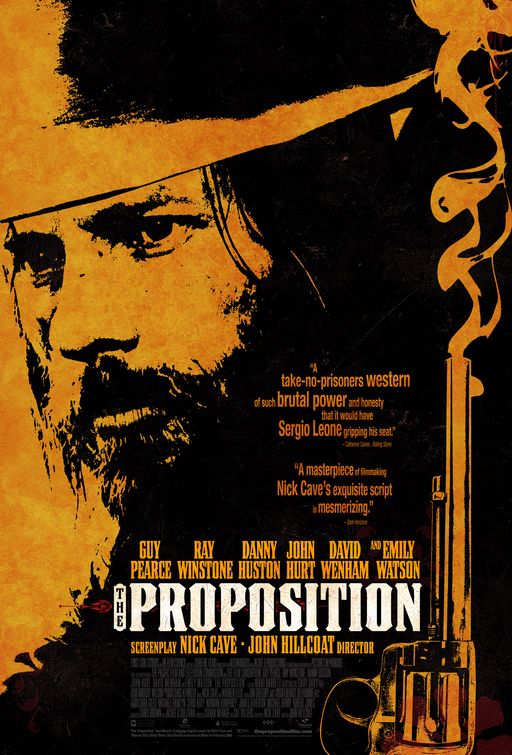
The Proposition (2006, Australia). Singer Nick Cave penned the script to this brutal and spare Australian outback western and it’s a dark, intense affair (like a lot of Cave’s music has been over the years). On display in The Proposition is violence, bloodletting, gaunt actors, flies, unshaved dirty men with filthy teeth. This had some of the most primal bursts of violence I’ve seen in a while and I loved it. Guy Pearce plays an outlaw who is given the choice to save one brother by killing another by a desperate lawman. Pearce, who is unbelievably filthy and emaciated in this, journeys to his brother who is hiding in a cave and contemplates killing him. Great to see a western again and I highly recommend this film as it’s going to be one of my favorites of the year. Spare, dark, literate, atmospheric and hauntingly violent.
Inside Man (2006, USA). This was a very pleasant surprise from director Spike Lee that is the best thing he's directed in a long time. It's a straight up genre picture from Lee—a thriller set around a New York City bank heist. Lee often weighs his films down with heavyhanded statements that almost ruin everything else in the film but he doesn't do that here and I'm thankfull for that. Great cast, great fun and one of the better heist films I've seen in a while.
Raising Victor Vargas (2003, USA). This is a sweet little independent film about a teen who thinks he's a ladies man who gets caught in bed with «Fat Donna». In an attempt to up his street cred in the neighborhood begins to woo the unattainable «Juicy» Judy. This Judy is a challenge, a firecracker who takes no crap and doesn't want anything to do with the immature neighborhood boys. Raising Victor Vargas has a captivating performance by Altagracia Guzman as Victor's religious, put-upon Grandma who is raising him and his siblings. Guzman is so great in this I wanted to see more of her days and not the teenagers on display. She's not really an actor as this was her first role (she was 72 during filming) but I just loved her performance more than anyone elses in this.
The Devil and Daniel Johnston (2006, USA). This is a fascinating documentary that tells the story of one of the great, largely unknown songwriters of the past 25 years. Johnston’s raw music, often full of innocence, wonder and sweetness, and sung in his unique, off-key voice, exists despite the fact he has battled extreme bouts of manic depression and other mental illnesses over the past two decades. Johnston has been in and out of institutions and passed around various family members while never giving up his music or art pursuits. The documentary attempts to tell us Johnston’s life while also exploring just how completely depression can destroy the creative impulse, as Johnston is only a shell of himself due to the various medications he takes. I've never been much of a fan of Johnston's but The Devil and Daniel Johnston is a bittersweet, poignant, humorous, lovingly created tribute to an eccentric American original that battles his demons via song and lives on in rock and roll lore as a legendary figure of the underground.
Friends With Money (2006, USA). Kind of a disappointment here. Nicole Holofcener makes this a little too caustic and bitter for me—I know, that’s kind of her way of doing things but I guess I just wasn’t in the mood. Some rich friends (and one poorer one) sit around and whine about their marriages and lives blah blah blah. I really loved Holofcener’s Lovely and Amazing from 2001 but this one didn’t do it for me.
An Inconvenient Truth (2006, USA). The end is nigh. Maybe in my lifetime we’ll in a complete disaster zone of a planet. At least that’s Al Gore’s contention in this riveting documentary based around his environmental slide shows that he’s been putting on. As Gore simply illustrates just how much damage has been done to the climate (even I grasp the dire implications and I’m a science nitwit) I was swamped by two main questions: 1/ How world leaders let global warming evolve to the state that it’s in and 2/ How in the hell did Gore lose the 2000 election to George W. Bush? Right, he didn’t really lose did he? Guess I’m still bitter and seeing what ol’ W. has done the past 6 years I have a right to that bitterness as it's been one bonehead move after another.
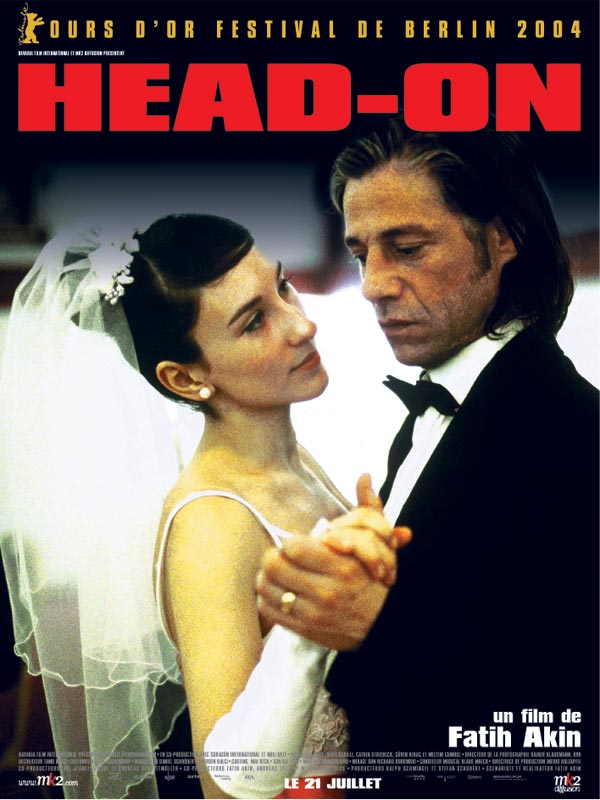 With the German film Head-On (2004), writer/director Fatih Akin has fashioned a film that is powerful, intense, gloomy, romantic and drowning in the kind of despair that you only get to witness in movies from another country. Head-On is just so unrelenting in its bleak outlook on life that there is no way in the world it would have been made by Hollywood.